News
Submission to the Transport and Other Legislation Amendment Bill 2026
In July, QNADA made a submission to the Transport and Other Legislation Amendment Bill 2026.
Our submission emphasised the importance of taking an evidenced based approach to road safety. We noted that the current approach to roadside drug testing continues a prohibitionist ‘zero tolerance’ policy by testing for the presence of, rather than impairment by, relevant substances (methylamphetamine, MDMA, cocaine and THC). This approach extends criminalisation for people who use not only illicit substances, but people using prescribed drugs for the first time, based on the contestable notion that mere presence is equal to impairment.
We recommended that efforts must be redirected to understanding impairment in order to educate patients about managing the risk, instead of penalising patients for the mere presence of a substance.
You can find our submission here.
You can also hear our CEO, Rebecca Lang, talk with the Committee considering these amendments at Parliament House (1.21): here.
Submission to the Inquiry into the Illegal Tobacco Crisis in Australia 2026
In March, QNADA made a submission to the Inquiry into the Illegal Tobacco Crisis in Australia 2026.
QNADA acknowledges the importance of taking further action to respond to the rapidly growing unregulated (i.e., illicit) tobacco market.
Our submission focuses on the issues with Australia’s current supply reduction approach to illicit tobacco and the need to expand on demand and harm reduction efforts. We support effective responses to tobacco and other smoking products use which are evidence informed and likely to increase individual and community safety, as outlined in our policy position paper on effective responses to drug use.
You can read the full submission here.
You can ready our policy position paper on ‘Effective Responses to Drug Use’ here.
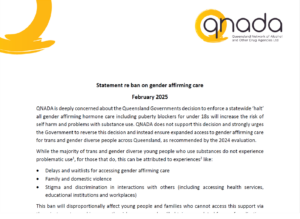
Statement re ban on gender affirming care
QNADA is deeply concerned about the Queensland Government’s decision to enforce a statewide ‘halt’ to all gender affirming hormone care including puberty blockers. This ban will disproportionately affect young people and families who cannot access this support through the private sector, and increases the risk young people will obtain unregulated forms of medication. You can read the statement here Fin_20250220_Statement re ban on gender affirming care.